Uber Trains and the Eurostar Green Benchmark
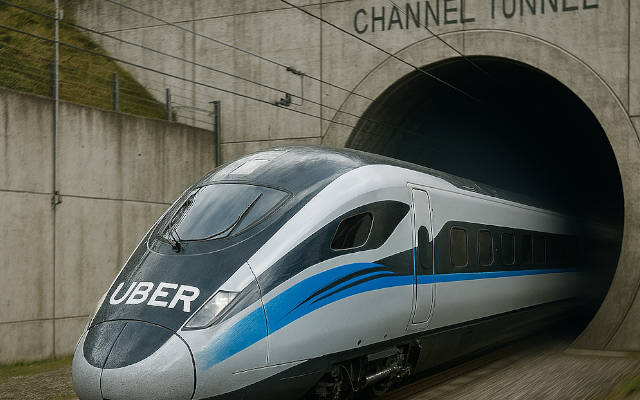
AI-imagined view of Uber Train emerging from the Euro Tunnel in 2029
By EVWorld.com Si Editorial Team
When it comes to high-speed travel through the Channel Tunnel, Eurostar has set the standard not only in speed and service but increasingly in sustainability. In 2024, the company pledged to power its trains with 100% renewable energy by 2030, one of the most ambitious commitments in the rail sector.
Where Will That Power Come From?
Expected sources include expanding offshore wind in the North Sea, growing utility solar in the UK and France, battery storage systems to smooth intermittency, and—particularly in France—low-carbon nuclear baseload that underpins a decarbonizing grid. Eurostar’s target relies on renewable guarantees of origin to match electricity use with verified green generation across the UK and EU.
Why Uber Trains Will Likely Follow Suit
Uber’s co-branding with Gemini Trains will use the same electrified, cross-border infrastructure as Eurostar. Given the competitive optics around climate performance and shared dependence on UK–EU grids, it’s reasonable to expect procurement strategies that mirror Eurostar’s—leaning heavily on offshore wind, supplemented by solar, storage, and low-carbon baseload where applicable.
Green Travel as a Market Advantage
By the time services are projected to begin near 2029, travelers will expect both affordability and climate responsibility. Aligning with Eurostar’s 100% renewable target by 2030 is likely to be table stakes for market credibility.
Carbon Footprint & Time: London → Paris (Train vs. Plane)
Estimated CO₂e per passenger (one-way)
Train (Eurostar): ~ 2–11 kg CO₂e per passenger. Lower-bound intensity estimates for Eurostar-type high-speed rail are ~4 g CO₂ per passenger-km (≈1.8–2.0 kg over ~450–500 km). Higher-bound practical estimates (including broader factors) put a one-way trip around ~11 kg CO₂e. Sources: Our World in Data; The Man in Seat 61.
Plane (short-haul): ~ 50–120 kg CO₂e per passenger (one-way). Short-haul averages around ~154 g CO₂ per passenger-km (≈50–80 kg over the ~330–350 km flight sector), with methodology that includes non-CO₂ effects (radiative forcing) pushing some estimates closer to ~120 kg. Sources: Our World in Data; The Man in Seat 61.
Takeaway: Even using conservative assumptions, Eurostar’s per-passenger footprint is typically ~5× to 25× lower than flying the same corridor.
Door-to-door travel time (city-centre to city-centre)
Eurostar: Fastest scheduled time ~2h16 from London St Pancras to Paris Gare du Nord, both central hubs. Recommended station arrival is ~1h15 before departure for border/security. Realistic door-to-door is often ~3.5–4 hours including modest local transfers. Sources: Eurostar times; The Times Eurostar guide.
Flight: In-air time is ~1h15, but door-to-door is typically ~4–5 hours once you add airport travel, check-in/security, and baggage/transfer at CDG/Orly. Sources: Tripyana overview.
Bottom Line
City-centre Eurostar usually matches—or beats—flying on total elapsed time while delivering an order-of-magnitude lower carbon footprint. As Eurostar moves to 100% renewable electricity by 2030, and competitors like Uber/Gemini enter the market, the London–Paris rail corridor is poised to become even cleaner.
Sources
- Eurostar – Sustainable Travel (2030 goal)
- Eurostar – London to Paris journey time
- The Times – Eurostar guide (arrival timing)
- Our World in Data – Travel carbon intensities
- The Man in Seat 61 – CO₂ comparison London–Paris
- Tripyana – Flight vs train time overview
Original Backlink
Views:107

Articles featured here are generated by supervised Synthetic Intelligence (AKA "Artificial Intelligence").